Low Glycemic Index Diet: What Hidden Sugars Mean for Ozempic, Wegovy, and Mounjaro Results
You’ve bought the “healthy” version of everything for years and the weight still hasn’t moved. A low glycemic index diet doesn’t have a mascot or a supplement to sell, which is probably why nobody talks about it. Here’s what it actually does for Ozempic, Wegovy, and Mounjaro users.
Table of contents
You’ve been buying the “healthy” version for years. Whole wheat crackers, low-fat yogurt, granola with the green leaf on the label. And the weight still hasn’t moved.
That’s not a willpower problem. A low glycemic index diet doesn’t have a mascot, a shake, or a supplement to sell you, which is probably why almost nobody talks about it. A good GLP-1 diet is one that eliminates hidden sugars and is in essence a low glycemic index diet itself. It’s one of the few things that actually matter if you’re on Ozempic, Wegovy, or Mounjaro and the scale isn’t cooperating. Here’s what it actually does, and what’s been hiding in your “healthy” cart the whole time.
The Problem: Sugar Hides From Your Low Glycemic Index Diet
Manufacturers don’t just write “sugar” on a label. There are more than 60 names for added sugar, and most of them are designed to not sound like sugar at all.
Some of the most common ones to watch for:
- Dextrose
- Maltodextrin
- Rice syrup
- Cane juice or evaporated cane juice
- Agave nectar
- Fruit juice concentrate
- Barley malt
A common industry trick is splitting sugar across two or three of these names in a single product. Individually, none of them rank high enough on the ingredient list to show up in the first few spots, even though combined they might be the single largest ingredient in the product.
Maltodextrin deserves its own callout here. It doesn’t taste sweet, so people assume it’s neutral. It’s not. Maltodextrin has a higher glycemic index than table sugar, and it shows up constantly in “healthy” processed snacks, protein powders, and sauces. Swapping a processed snack for something like a high-protein cottage cheese recipe keeps the protein without the hidden spike, and it’s the kind of substitution that makes a low glycemic index diet sustainable instead of restrictive.
What Glycemic Index Actually Measures
Glycemic index (GI) measures how quickly a food raises blood glucose compared to pure glucose, which is set at 100. High-GI foods spike blood sugar fast. Low-GI foods raise it more gradually.
GI alone can be misleading, though. That’s where glycemic load (GL) comes in — it accounts for how much carbohydrate is actually in a typical serving. Watermelon is a good example: high GI, but low GL, because a serving doesn’t contain that much carbohydrate in the first place. Harvard Health has a solid breakdown of the difference if you want the full mechanics. This GI/GL distinction is the actual engine behind a low glycemic index diet — it’s not just “avoid sugar,” it’s understanding how fast and how much a food moves your blood sugar.
Why this matters specifically for GLP-1 users: Low glycemic eating doesn’t just mean cutting carbs. I explain which ones help in what you need to know about carbs on a GLP-1 diet.
Semaglutide and tirzepatide slow gastric emptying, which is part of why they suppress appetite. But hidden sugars can still cause blood sugar spikes and crashes underneath that effect. Those crashes work against the medication, not with it, and they can blunt the metabolic benefits you’re taking the medication to get in the first place.
Where Hidden Sugars Hide Worst
The savory aisle is where most people get caught off guard:
- Pasta sauce
- Salad dressing
- Bread
- Deli meat
- Crackers
Then there’s the “healthy halo” category, foods that are marketed on wellness claims but loaded with sugar anyway:
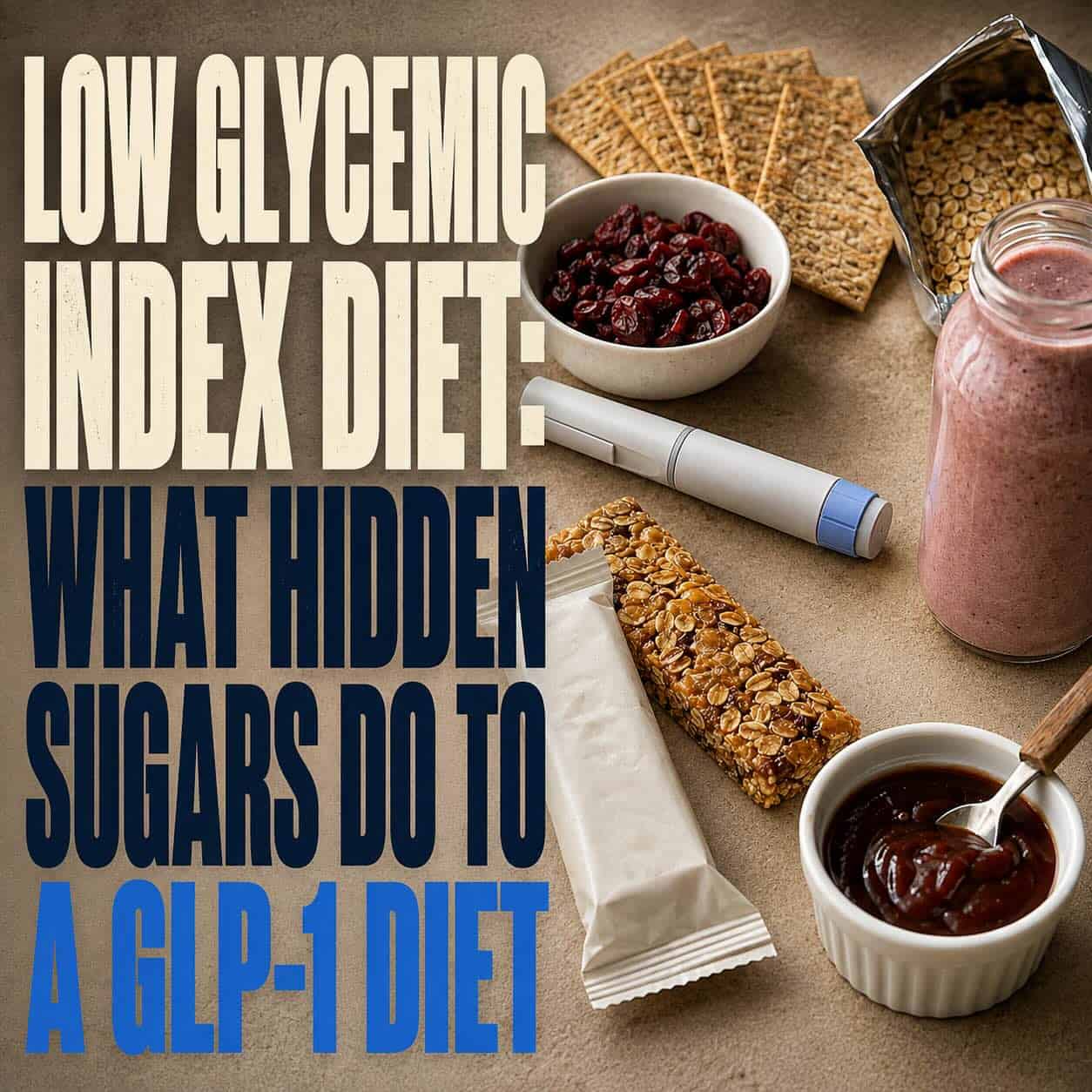
- Granola bars
- Smoothies (especially bottled or pre-made — [a homemade Ninja Creami recipe] gets you the same texture without the syrup base)
- Dried fruit
- Flavored oatmeal packets
And the condiment aisle, which is arguably the worst offender:
- Ketchup
- BBQ sauce
- Teriyaki sauce
- Some mustards
How to Read a Label on a Low Glycemic Index Diet (3-Step Check)
- Total sugar grams — the baseline number, includes naturally occurring and added sugar
- Added sugar grams — the number that actually matters for your goals
- Ingredient list position — where sugar (in any of its names) falls in the list
Rule of thumb: if sugar, under any alias, shows up in the first three ingredients, treat that product like a dessert, regardless of what aisle it came from or what the packaging claims.
For reference, the American Heart Association recommends capping added sugar at 25g/day for women and 36g/day for men. Use it as a reference point, not a rigid target, since context (activity level, medication, overall diet) matters more than hitting an exact number.
The Bigger Picture
This is another example of how the food industry manipulates products to look healthier than they are. It’s not an accident that sugar has 60 different names, or that it gets split across multiple ingredients so it doesn’t rank first. Learning to read past the marketing is one of the most useful skills you can build on a GLP-1 medication, because the medication only does part of the work. The food still matters.
Once I started checking ingredient lists instead of front-of-package claims, what I actually bought changed almost completely. It’s a small habit that adds up fast, and it’s the difference between a low glycemic index diet that actually works and one that just swaps one marketing claim for another. I walked through this in video form too, in using a low glycemic diet for GLP-1 success.
If you’re interested in more information about the GLP-1 diet as the answer to an industry that wants to keep us fat and addicted be sure to watch my video GLP-1 Diet: Is It the Fix for an Industry Designed to Keep Us Sick? to learn more.