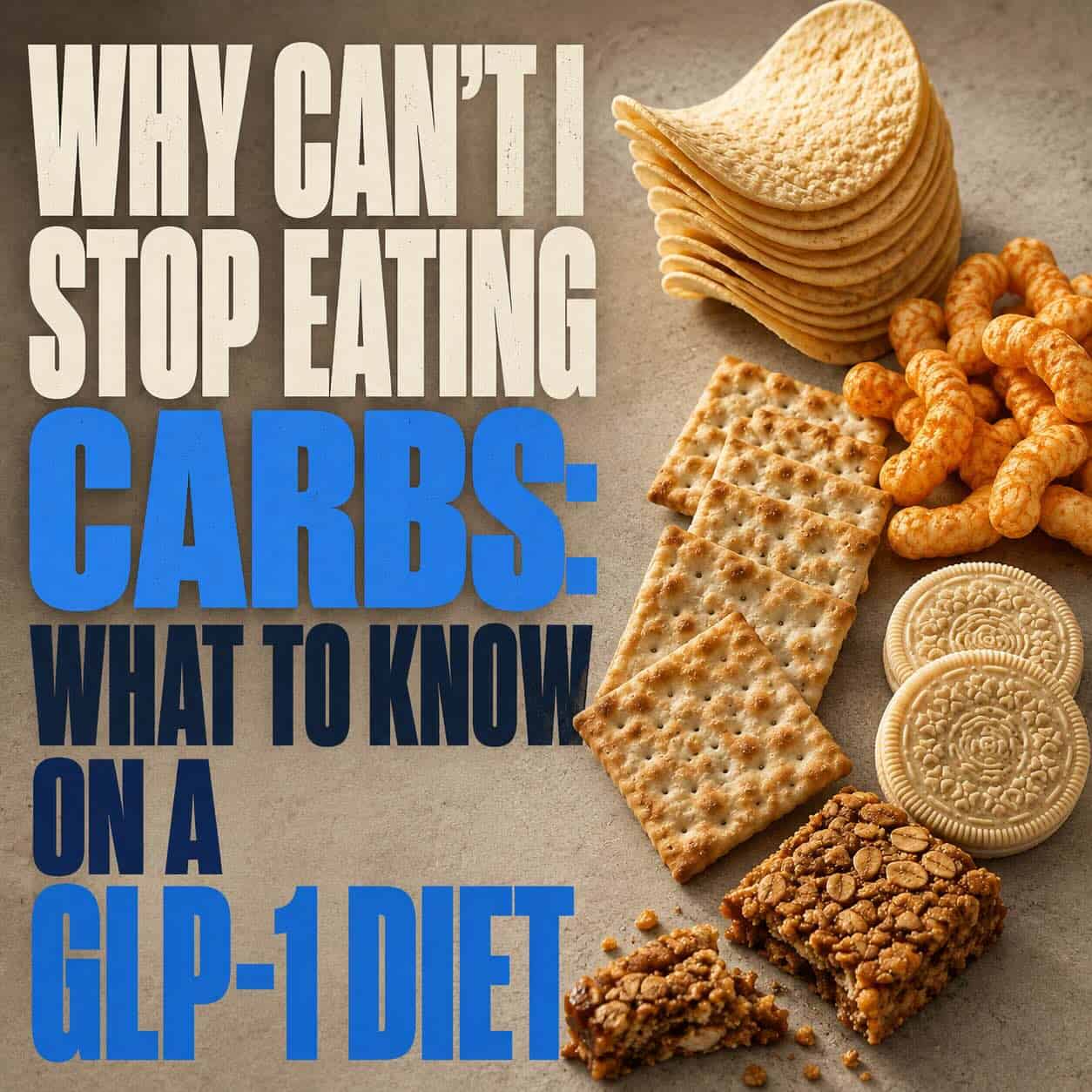
Why Can’t I Stop Eating Carbs? What To Know on a GLP-1 Diet
You are not weak-willed. Here’s why you can’t stop eating carbs, who engineered the craving, and what to do about it on a GLP-1 diet.
Table of contents
- When Did Snacking Become Normal?
- Who Bought the Snack Aisle: Big Tobacco Moves Into Food
- The Lunchables Case Study
- Why Carbs Don’t Fill You Up: Vanishing Caloric Density
- Are Snack Foods Designed to Be Addictive?
- Trans Fats, Hidden Sugars, and Starch Built to Digest Instantly
- How “Snacking Is Healthy” Became Conventional Wisdom
- April 8, 1999: The Day the Food Industry Voted No
- How Much of Our Food Is Engineered This Way?
- Why Carb Cravings Go Quiet on a GLP-1
- How to Stop Eating Carbs Constantly (Without White-Knuckling It)
- Frequently Asked Questions
There was a rule in my house growing up. I bet there was one in yours too.
No snacking before dinner. You’ll ruin your appetite.
Nobody says that anymore. Somewhere between then and now, the advice flipped. Eat every three hours. Keep your metabolism up. Always carry a snack.
So if you have ever stood in your kitchen at three in the afternoon, hand in a bag of chips, wondering why can’t I stop eating carbs, let me clear one thing up first. This is not a character flaw. Someone engineered that craving. Then they marketed it, and they sold it to you.
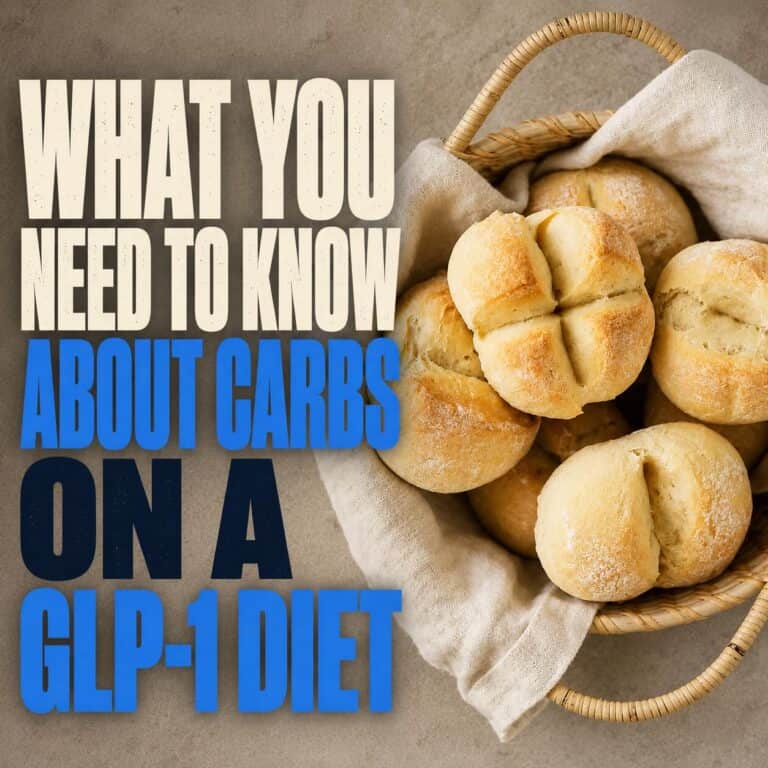
This post sits underneath what you need to know about carbs on a GLP-1 diet, which covers the practical side. How many carbs. Which ones. When. This post answers the question underneath that one. Why are the carbs in the snack aisle so much harder to put down than the carbs on your plate?
Much of the answer hides inside the package. I have written before about hidden sugar in foods and metabolic resistance and what hidden sugars mean on a low glycemic index diet. The short version: snack makers rarely label the sugar as sugar. They never put it there by accident.
The defense turns out to be simpler than the problem. Snacking fills the hole where a real meal should have gone. When I eat an actual meal with protein, fat, and enough structure to need a fork, the three o’clock question never comes up. My chuckwagon chili with stew meat is what I cook when I know a long afternoon is coming. It takes intention on the front end. That is the whole point.
Here is how we got here.
When Did Snacking Become Normal?
For most of American history, people ate meals. Snacking existed, but it carried a whiff of cheating.
Then the industry went to work. The Smithsonian dates the shift to the years between 1950 and 2000, when manufacturers turned the country into a nation of snackers.
The tell in the marketing
One artifact gives the game away. A mid-century potato chip tin promised customers “Feast without Fear.”
Read that again. The fear came first. Before anyone could sell you a daily snack habit, they had to dismantle the guilt attached to it.
Fritos went national in 1950 after C.E. Doolin applied Henry Ford’s assembly line to a Mexican street food. Casa de Fritos opened at Disneyland in 1955. Snacking got a mascot, a theme park storefront, and a permission slip.
The slogans confessed
By 1963, Lay’s ran a slogan that told you exactly what the product did to you. “Betcha can’t eat just one.”
Pringles said it even more plainly. “Once you pop, you can’t stop.”
We heard those lines as charm. They were product specifications.
Who Bought the Snack Aisle: Big Tobacco Moves Into Food
Here is the part most people do not know. In the mid-1980s, tobacco companies bought the American snack aisle.
Philip Morris acquired General Foods in 1985. It bought Kraft in 1988. R.J. Reynolds took Nabisco in 1985. Philip Morris did not fully divest Kraft until 2007.
So for roughly two decades, cigarette companies owned the brands in your pantry. Those are exactly the years when the snacking rule flipped.
The research backs it up
Researchers at the University of Kansas tested whether that ownership changed the food. It did.
Their 2023 study in Addiction compared tobacco-owned brands against competitors between 1988 and 2001. Tobacco-owned foods were 29% more likely to be fat-and-sodium hyperpalatable, and 80% more likely to be carb-and-sodium hyperpalatable.
Lead author Tera Fazzino put it simply. These combinations do not exist in nature, so our bodies never learned to handle them.
They used cigarette science on purpose
A newer study makes the link explicit. In June 2026, UCSF researcher Laura Schmidt published findings in the American Journal of Public Health based on internal company documents.
Philip Morris moved flavor science straight from its tobacco division into its food division. Executives called these “technical synergies.”
Then it gets stranger. When Low-Fat Lunchables tested badly on taste, designers brought in tobacco neuroscience staff. That team ran EEG brain-wave tests to optimize the artificial fat.
Schmidt’s summary is blunt. They used cigarette science to design these food products.
The Lunchables Case Study
One product carries this whole story in a yellow plastic tray.
Bob Drane developed Lunchables at Oscar Mayer between 1985 and 1991. It earned $218 million in its first year.
An internal memo explained the concept. “Lunchables aren’t about lunch. It’s about kids being able to put together what they want to eat, anytime, anywhere.”
That sentence abolishes the meal. Someone wrote it down, on purpose, as a strategy.
The advertising sold autonomy from adults. “All day, you gotta do what they say. But lunchtime is all yours.” Cigarette marketers had sold teenagers the same feeling for decades.
Later versions added Snickers, M&Ms, and a sugary drink. The “Maxed Out” line carried nine grams of saturated fat and thirteen teaspoons of sugar.
Why Carbs Don’t Fill You Up: Vanishing Caloric Density
Now to the mechanism. Why can you finish a whole bag and still feel unsatisfied?
Food scientist Steven Witherly gave the answer a name: vanishing caloric density.
How the trick works
Witherly described the effect this way. If something melts down quickly, your brain concludes there were no calories in it. So you keep eating.
Your satiety system needs time and physical resistance to file its report. A chip that dissolves in four seconds never gives it either one.
That is your Pringles problem, and it has a technical name. The food is engineered to disappear before your body can object.
The bliss point
A second technique compounds the first. Howard Moskowitz, a Harvard-trained experimental psychologist, industrialized the search for the perfect ratio of sugar, salt, and fat.
He called the target the bliss point. For one Dr Pepper flavor, his team ran 61 formulas through 3,904 tastings.
Blandness as a weapon
Moskowitz also found something counterintuitive. Big, distinct flavors overwhelm the brain, and the brain responds by shutting down desire. Researchers call this sensory-specific satiety.
So mass-market snacks avoid one dominant flavor deliberately. The product never triggers your “enough” signal, because designers removed the thing that would trigger it.
Are Snack Foods Designed to Be Addictive?
That question sounds dramatic. The evidence is not.
Frito-Lay spent up to $30 million a year studying crunch, mouthfeel, and aroma. Company scientist Robert Lin documented an internal awareness that people get addicted to salt. A 2011 Harvard analysis found potato chips drove more weight gain than any other food it tested.
The study that ends the willpower argument
In 2019, NIH researcher Kevin Hall ran the trial that settles the practical question.
Twenty adults lived in a metabolic ward for four weeks. They ate ultra-processed food for two weeks and whole food for two weeks. Researchers matched both diets for calories, sugar, fat, fiber, and sodium. Participants ate as much as they wanted.
On ultra-processed food, they ate about 500 more calories per day. They ate faster. They gained two pounds in two weeks, then lost it on whole food.
Same calories on the label. Different behavior from the eater. Hall called it the first study to demonstrate causality.
Where scientists still disagree
I want to be straight with you here. Researchers have argued that ultra-processed foods meet the established criteria used to classify addictive substances, including the criteria once applied to tobacco.
Other scientists push back on the word “addiction.” That debate is real and unsettled.
But you do not need to win that argument. Hall’s trial already proved the practical point. The food changes what you do.
Trans Fats, Hidden Sugars, and Starch Built to Digest Instantly
The engineering happened in the ingredient list too.
Trans fats bought the shelf life
Partially hydrogenated oil made a national snack aisle physically possible. It gave manufacturers fat that would not go rancid on a truck.
Regulators moved slowly. The FDA required trans fat on labels in 2006. It issued a preliminary safety determination in November 2013. The final determination came on June 16, 2015, with compliance deadlines running through 2018 and beyond.
That is roughly fifty years of a mass-market ingredient, retired only after the harm became impossible to deny.
The sugar industry bought the science
In 1967, the sugar trade association paid Harvard researchers roughly $50,000 in today’s money. Those researchers published a review in the New England Journal of Medicine that blamed heart disease on fat and waved off sugar.
Nobody disclosed the funding. UCSF researchers uncovered the arrangement in 2016.
That single review helped launch the low-fat era. And the low-fat era handed the snack industry its greatest product category: the fat-free, sugar-loaded “healthy” snack.
Starch that acts like sugar
Refined starch completes the set. Manufacturers mill and cook it until it digests almost instantly.
At that point it stops behaving like food and starts behaving like a delivery system. My post on hidden sugars and the low glycemic index diet covers what that does to your blood sugar.
How “Snacking Is Healthy” Became Conventional Wisdom
The industry still needed to flip the rule. It used four levers.
Lever one: manufacture the advice
“Eat every three hours to boost your metabolism” spread as common sense. The controlled evidence for that claim stayed thin. Total intake matters far more than how you divide it up.
Notice the pattern. The advice that helped the snack aisle most arrived with the least evidence behind it.
Lever two: fund the framing
Coca-Cola ran the modern version of this play. In 2015, the company funded the Global Energy Balance Network, which pushed the idea that inactivity, not diet, drove obesity.
Emails surfaced. The group dissolved within months. Same move as 1967, new decade.
Lever three: sell the halo
Granola bars. Baked chips. 100-calorie packs. Protein bars.
A health claim on the front of a box works as a permission slip. And permission is what turns one serving into three.
Lever four: rename the meal
The industry even has a word for its goal. Snackification.
Mondelez publishes an annual report on this. Its findings are remarkable: 91% of consumers snack daily, and 62% now prefer grazing over three meals, up from 58% in 2022. Among Millennials and Gen Z, that figure hits 71%.
A snack company measures the death of the meal. Then it celebrates the trend in a press release.
April 8, 1999: The Day the Food Industry Voted No
They knew. That is the part I cannot get past.
On April 8, 1999, eleven CEOs met privately at Pillsbury headquarters. Nestle, Kraft, Nabisco, General Mills, Procter & Gamble, Coca-Cola, and Mars all sent leadership.
Kraft executive Michael Mudd presented 114 slides. Half of American adults were overweight. Forty million were clinically obese. Childhood obesity had more than doubled since 1980.
Then Mudd proposed a fix. The industry should use its own science to understand overeating. It should adopt industry-wide limits on salt, sugar, and fat. It should write a marketing code for children.
Stephen Sanger of General Mills killed it. “Don’t talk to me about nutrition,” he said. “Talk to me about taste, and if this stuff tastes better, don’t run around trying to sell stuff that doesn’t taste good.”
Philip Morris CEO Geoffrey Bible offered the trapped-competitor defense. If we give them less, they’ll buy less, and the competitor will get our market. So you’re sort of trapped.
They held the meeting. The data was well known and understood. They voted no.
Everything since followed from that vote.
How Much of Our Food Is Engineered This Way?
The results show up in the numbers.
Using a quantitative definition, researchers found that 62% of foods in the USDA database qualify as hyperpalatable. That figure includes products labeled “low fat” and “reduced,” which tells you how little those labels mean.
What it did to kids
The childhood data lands hardest. USDA figures show that 93% of American children and adolescents snack on a given day.
Snacks supply about 27% of their calories. They supply 42% of their added sugar. For one child in ten, snacks deliver more than half of daily energy.
Chips, cookies, and candy reach roughly 75% of snacking kids. Fruit reaches about 25%.
What it did to the rest of us
Adults show the same pattern in a different form. Survey data indicates 56% of Americans now replace meals with snacks.
More telling: 66% describe their snacking as spontaneous. Only 11% call it planned.
The industry did not just add a food category. It installed an unplanned eating occasion in the middle of your afternoon.
Why Carb Cravings Go Quiet on a GLP-1
Here is the evidence I find most convincing, and it comes from your own medicine cabinet.
If snacking answered a real appetite need, then quieting appetite would barely dent snack sales. Instead it guts them.
What the purchase data shows
Cornell researchers tracked about 150,000 households. They published the results in the Journal of Marketing Research in December 2025.
Within six months of starting a GLP-1, households cut grocery spending by 5.3%. Savory snacks fell roughly 10%. Sweets, cookies, and baked goods dropped by similar margins.
Almost nothing rose. Yogurt and fresh fruit were the rare exceptions.
The reversal proves the point
Then comes the detail that settles it. About a third of users stopped the medication during the study. Their spending snapped right back to previous patterns.
Many people describe this experience as food noise going quiet. I would put it differently.
That noise was not natural. An industry spent forty years and billions of dollars installing it. The quiet is just what your appetite sounds like without a marketing campaign running on top of it.
How to Stop Eating Carbs Constantly (Without White-Knuckling It)
You did not lose an argument with yourself. You walked into a system built by professionals. So build a defense instead of relying on willpower.
Eat the meal
Snacking fills the gap where a meal should have been. Close the gap and the craving loses its opening.
That means cooking with intention. My chuckwagon chili with stew meat holds for hours because it has protein, fat, and actual structure. Front-load the effort and the afternoon takes care of itself.
Choose foods that fight back
Vanishing caloric density is the enemy. Texture is the antidote.
Pick foods that require chewing and take time to break down. They are the structural opposite of an engineered snack. When I want something that eats like a carb and isn’t one, it’s the high protein pasta salad.
Plan it or skip it
Remember the 66% versus 11% split. Spontaneous snacking is the whole problem in one statistic.
Decide in advance whether a snack happens. A planned snack is food. An unplanned one is usually a marketing result.
Read the back, not the front
The front of the box sells permission. The ingredient list tells the truth.
Start with my guide to hidden sugar in foods, then work through the practical carb targets in what you need to know about carbs on a GLP-1 diet.
Let hunger mean something again
Arriving hungry at dinner is not failure. It means the instrument works.
My grandmother was right. She just never guessed how much money would go into proving her wrong.
Frequently Asked Questions
Partly biology, partly design. Refined carbs reach your bloodstream fast and trigger a strong reward response. Packaged snacks then amplify that response through engineered combinations of fat, sugar, salt, and refined starch. Whole-food carbs break down slower and do not drive the same cycle.
Hyperpalatable foods combine fat, sugar, salt, and refined carbs in ratios that maximize reward and make stopping difficult. Under the quantitative definition researchers use, about 62% of items in the USDA food database qualify. That total includes many products marketed as “low fat” or “reduced.”
Scientists still debate the word. They do not debate the behavior. In a controlled NIH trial, people ate roughly 500 more calories a day on ultra-processed food than on whole food, even with calories and nutrients matched. The food changed what they did.
It describes a snack engineered to melt fast. When food dissolves quickly, your brain registers almost no calories and lets you keep eating. Food scientist Steven Witherly named the effect while explaining why people finish an entire bag without feeling full.
An apple is not the problem. The engineered snack is. The real issue is what fills the snack aisle, plus the fact that most snacking now happens without a decision. Roughly two-thirds of Americans describe their snacking as spontaneous.
Evening cravings usually trace back to the earlier part of the day. A small lunch, a low-protein breakfast, fatigue, and plain habit all push the deficit later. Building a bigger, more structured meal earlier works better than fighting the craving at nine o’clock.
The evidence is weak. Total intake matters far more than how many times you divide it. Worth noticing: the advice that most benefited the snack industry arrived with some of the thinnest evidence behind it.
Between roughly 1950 and 2000. The Smithsonian traces the shift to decades of manufacturing and marketing that turned snacking from a minor habit into a daily expectation. A mid-century chip tin advertised “Feast without Fear,” which shows what marketers had to overcome first.
Reach for protein, fiber, and something that requires chewing. Eggs, Greek yogurt, cottage cheese, jerky, nuts, and leftovers from a real meal all work. Texture matters as much as macros, because chewing gives your body time to register what arrived.
The Bottom Line
If you cannot stop eating carbs, you are not failing at something simple. You are losing to something complicated, and people built it that way on purpose. Food scientists studied your satiety signals so they could route around them. Marketers spent forty years turning a habit earlier generations warned about into an ordinary part of the day. None of that is a story about willpower. All of it is a story about design.
Design cuts both ways, though. Once you can name the mechanism, it loses most of its grip on you. Eat real meals. Pick food with texture. Decide about the snack before you are standing in front of it. And when you want the practical numbers for your own plan, start with what you need to know about carbs on a GLP-1 diet.
Nothing here is medical advice. Talk to your doctor about your own care and medications.